
What students, parents, and teachers should understand about performance pressure
Chair auditions.
All-State tryouts.
Musical theater callbacks.
Marching band leadership roles.
Solo competitions.
College entrance auditions.
For young performers, these moments can carry a surprising amount of weight.
They may represent progress, recognition, belonging, future opportunity, or simply the chance to find out whether months of preparation will hold up when someone is watching.
Some nervousness is expected. The harder question is what happens when the pressure begins to change how a student prepares, performs, or understands themselves.
Why these moments can feel so important
Students in competitive programs often care deeply about what they do.
They may also:
hold themselves to very high standards
compare themselves closely with peers
worry about disappointing teachers, coaches, or family
attach meaning to rankings, placements, and auditions
begin to see performance results as evidence about who they are
This can make evaluation feel unusually personal.
A chair placement is technically a chair placement. An audition result is technically a result. But to the student, it may also feel like a judgment about talent, belonging, potential, or future direction.
That added meaning changes the experience of pressure.
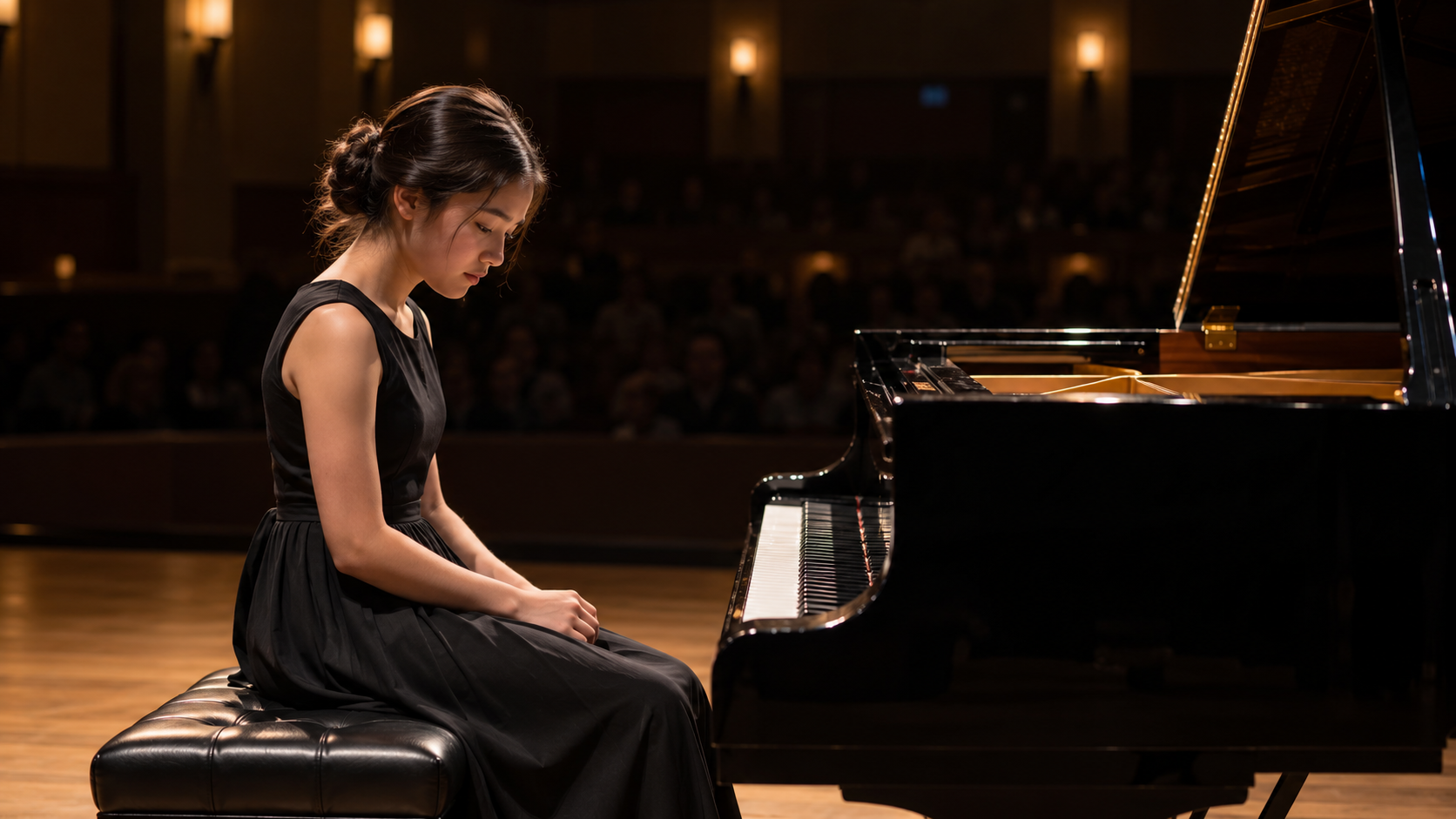
What pressure can change during performance
A student may know the material well and still find that something shifts under evaluation.
Attention becomes more self-conscious.
Physical sensations become harder to ignore.
Mistakes feel larger.
The performer may begin monitoring technique that normally runs automatically. Some students become cautious and others rush. Some lose concentration after a small error, because they are already thinking about what that error means. This is one reason a student can play beautifully in practice and struggle in an audition.
Read: Why Musicians Often Play Worse in Auditions Than in Practice
These experiences do not mean the student lacks ability. They reveal that performing under evaluation is its own skill.
Young performers are learning more than repertoire
One of the most valuable things about music, theater, dance, athletics, and other performance environments is that they give young people repeated opportunities to practice doing something meaningful while being observed.
They learn how to prepare.
They learn how to make decisions under pressure.
They learn how to recover after mistakes.
They learn how to receive feedback.
They learn what happens when they care deeply about an outcome and cannot completely control it.
These are important skills. The goal is not to make every audition feel easy. The more useful aim is to help students become increasingly capable of functioning well when the moment feels important.
What helps
Technical preparation still matters. So does preparation for the conditions surrounding the performance.
A young performer can practice:
Performing under realistic conditions
Play the entire piece without stopping and then record one complete take. Perform for another person or create a mock audition. Practice at a predetermined time rather than waiting to feel ready. Give yourself one attempt.
These small changes begin teaching the student how to access preparation when conditions are less comfortable and less controllable.
Directing attention toward the task
Pressure often pulls attention toward questions such as:
What do they think of me?
What if I mess this up?
Am I shaking?
What happens if I lose?
Those thoughts can become very compelling. Students can learn to notice the pull and redirect attention toward something useful: the phrase, the breath, the next entrance, the ball, the argument, the first sentence, the person they are speaking to.
Attention is part of performance.
Recovering after mistakes
Young performers often assume that confidence means performing without mistakes, while a more durable form of confidence develops when they discover that they can continue after one. A missed note does not require a second missed note in the same way that a poor first answer does not determine the rest of an exam. A mistake creates a new moment, and the performer still has choices inside it.
Staying connected to what matters
Evaluation can quickly become the center of attention.
And it is true that rankings, results, and feedback matters. But they do not always tell the performer what to do in the next five seconds.
Before a performance, it can help to ask:
What do I want to bring to this?
Courage?
Commitment?
Expression?
Focus?
Energy?
Trust?
Curiosity?
That answer gives the student something more useful than simply trying to avoid failure.
Parents and teachers shape the performance environment too
Young performers learn from the adults around them how much meaning to assign to success, disappointment, criticism, and comparison. After an audition or competition, adults can help by asking questions such as:
What felt strong?
Where did pressure affect you?
What did you learn about your preparation?
What would you practice differently next time?
These questions keep the result connected to learning, and it also helps to separate feedback about a performance from conclusions about the performer.
A student can be ambitious, disappointed, competitive, and deeply invested in improvement without turning every result into a verdict about ability or worth.
A simple framework: FIND NORTH
When the moment itself arrives, young performers often need something much simpler than a long explanation.
FIND NORTH uses three steps:
What matters here?
Noise
What is pulling at me?
Next Move
What do I do now?
NORTH. NOISE. NEXT.
The goal is to help the performer stay oriented while pressure is present. This guide can be a helpful construct for even last minute application.
The longer view
Performance pressure does not disappear after high school. College auditions, advanced study, competitive programs, professional opportunities, interviews, presentations, and leadership roles all bring new forms of evaluation.
Young people who learn how to prepare, perform, recover, and stay oriented under pressure are building something larger than stage confidence. They are learning how to do difficult things well when the outcome matters.